What Beginners Need to Know About Their Traits & Applications
In our last blog, we broke down the core traits and practical uses of three foundational waxes—soy wax, paraffin wax, and palm wax—laying a solid groundwork for beginners to navigate the basics of wax selection. But the world of wax extends far beyond these three staples, and if you’re ready to expand your toolkit (whether for candle-making, DIY crafts, or small-batch projects), there are more essential varieties worth exploring.
Today, we’ll turn our focus to other four wax materials. By the end of this guide, you’ll not only understand their key characteristics but also know exactly when to reach for them instead of your go-to waxes, helping you take your creations to the next level.

Definition & Source:
Coconut wax is a natural wax extracted from coconut oil. Belonging to the palm family, its major production regions are in Southeast Asia (such as Thailand, Indonesia, etc.).
Characteristics
Low melting point: Generally 40-45℃, close to the temperature of human skin. When burning, the wax drips and only gives a warm sensation, ensuring high safety.
Texture and appearance: Smooth when melted, but in solid form, pure coconut wax tends to be uneven. It is often mixed with soy wax, palm wax, etc. to improve hardness and flatness.
Burning performance: Burns completely, smoke-free, has good oxidation stability, and a long burning time; when making cup wax, the surface is smooth and does not stick to the cup.
Advantages:
It is natural, safe, healthy and eco-friendly, and the melted wax can be used for massage after burning.
It has a warm matte texture, and the wax surface remains smooth with no residue left after burning.
Disadvantages:
It is relatively expensive and tends to melt easily under high temperatures or direct sunlight.
Pure coconut wax has poor fragrance diffusion. When mixed with essential oils, it solidifies too quickly, so it often needs to be blended with other types of waxes for use.
Usage: Aromatherapy candles, massage wax, low-temperature candles
Suitable For: jar scented candle, mold candle, tin candle.
High temperature will cause it to soften. So it is recommended to use it in combination with hard wax.

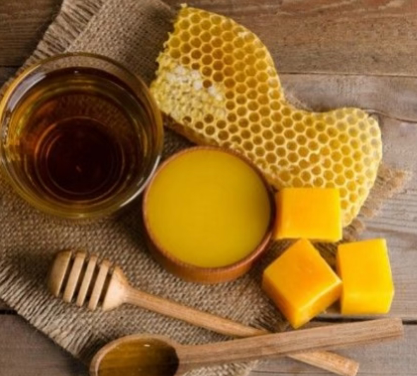

Source: A waxy substance secreted by bees.
Type: White beeswax &Yellow beeswax
Melting point: 62-63℃
Melting really easily, and no impurities, higher price
Aroma and Environmental Friendliness: Beeswax has a faint honey-like fragrance and produces almost no smoke when burned.
Combustion characteristics: The combustion speed is relatively slow, and the flame is stable. However, the flame may become unstable if there is too much essential oil.
Suitable For: candle, soap, lip balm, food wrap, cosmetics, body lotion


Synthetic clear gel solid
Colorless and transparent
Melting point: 55°C 85°C 95°C
Boiling point: > 330℃
Advantages: High transparency, excellent coloring effect, can be used to create various shapes and designs, with excellent decorative effect.
Disadvantages: High cost, prone to melting at high temperatures, and the fragrance diffusion effect is average when ignited.
Suitable For: craft candle, shaped candle
Jel wax is not recommended to be lit for a long time. During the burning process, it may emit an unpleasant odor.


This is a pre-mixed formula wax, and no further proportion adjustment is needed.
Main material: soy wax, coconut wax and other vegetable wax
Surface: white &soft solid
Package: 300g/bag
20KG/box or customized
Shelf life:12 months
Usage: Candle making
Melting point: Under gentle agitation, melt the wax to 75°C. Do not heat to above 90°C for prolonged periods of time.
Pour Temperature: Cool to 70°C then add fragrance oil and gently stir for 2 minutes to combine.
Suitable For: Jar Scented Candle, Tin Candle, Mold Candle
This article focuses on beginners, systematically introducing four additional wax varieties: coconut wax, beeswax, jelly wax, and blended wax. It centers on analyzing their traits and application scenarios, providing practical references for beginners to select and use different types of wax.
The article clarifies the key characteristics of each wax variety respectively: Coconut wax stands out for its fine texture and long-lasting fragrance retention; Beeswax has a natural honey scent, along with high hardness and strong heat resistance; Jelly wax, thanks to its transparent, gel-like appearance, performs excellently in decorative products; Blended wax balances the advantages and disadvantages of single wax varieties through the proportioning of different waxes, adapting to a wider range of needs. Meanwhile, corresponding to the characteristics of each wax type, the article also provides specific application directions such as scented candles and handmade jewelry, helping beginners quickly understand and get started.
Thank you for your reading and support.