- Home
-
-
Industrial 1000L Wax Melting Bucket For Large-Scale Candle Production
Views: 0 Author: Site Editor Publish Time: 2026-06-27 Origin: Site


Upgrading to a 1000L Wax Melter shifts your business from a manual craft setup to a highly controlled manufacturing operation. You must view this transition as a critical capital expenditure rather than a simple equipment purchase. The operational stakes run incredibly high at this volume. At the 1000L scale, minor temperature fluctuations cause immense material waste. Drainage inefficiencies lead to unacceptable downtime. A single rejected batch severely impacts your bottom line. You simply cannot afford to rely on trial and error.
Our objective is to equip plant managers and operations directors with an evidence-based evaluation framework. You will discover how to effectively shortlist and implement large capacity melting systems correctly. We will help you cut through inflated manufacturer claims. You will learn exactly what components truly matter for maintaining consistent output.
Key Takeaways
Capacity vs. Throughput: A 1000L tank typically supports continuous pouring of over 4,000 standard 8oz candles per batch, but actual throughput depends on pump flow rates (target ≥1 gal/min) and heating cycle times.
Thermal Management is Critical: True industrial systems require jacketed heating (water or thermal oil) and fully insulated tanks; direct heating risks scorching and degrades wax viscosity.
Verify Component Integrity: Focus on the build quality of pumps, PLCs, and heated hoses, as these are the most common points of failure in continuous candle production.
Demand Proof of Performance: Before procurement, require Machinery Test Reports (FAT) and video outgoing-inspections to validate temperature precision (±5°C or better) and drainage claims.
When to Scale to a 1000L Industrial Wax Melter
Identifying the exact moment to upgrade requires careful analysis of your daily workflow. You must clearly define your operational breaking points. A common bottleneck occurs when melting time paces significantly slower than pouring schedules. If your production team constantly waits for liquid material, you lose money daily. Labor hours wasted on monitoring multiple smaller tanks also signal a desperate need for equipment consolidation.
Consider these clear signs you have outgrown your current setup:
Your staff spends more than 20% of their shift manually refilling and monitoring small melters.
You frequently decline wholesale orders due to insufficient daily melting capacity.
Batch inconsistencies occur because operators juggle different temperatures across multiple small pots.
Calculating actual production value translates theoretical 1000L capacity into tangible business outcomes. Do not base your calculations solely on static volume. Instead, frame your math around continuous shift outputs. You must evaluate melting cycle times against cooling constraints. A massive machine might hold 1000 liters, but its true financial value lies in daily throughput. Fast cycle times generate higher revenue.
You must also weigh the benefits of consolidation against modularity. Relying on a single massive 1000L unit carries different risks than running two 500L units. A centralized 1000L approach minimizes your physical floor footprint. It also centralizes PLC integration for easier staff monitoring. However, a single tank creates a definitive single point of failure. If the unit goes offline, production stops completely. Running two smaller units offers valuable redundancy. You must decide which risk profile your facility can absorb.
Best Practice: Always map your projected 12-month volume before choosing between a single centralized tank and a dual-tank setup. Consider your maintenance capabilities and seasonal demand spikes.
Core Architecture: Differentiating Commercial Grade from Oversized Pots
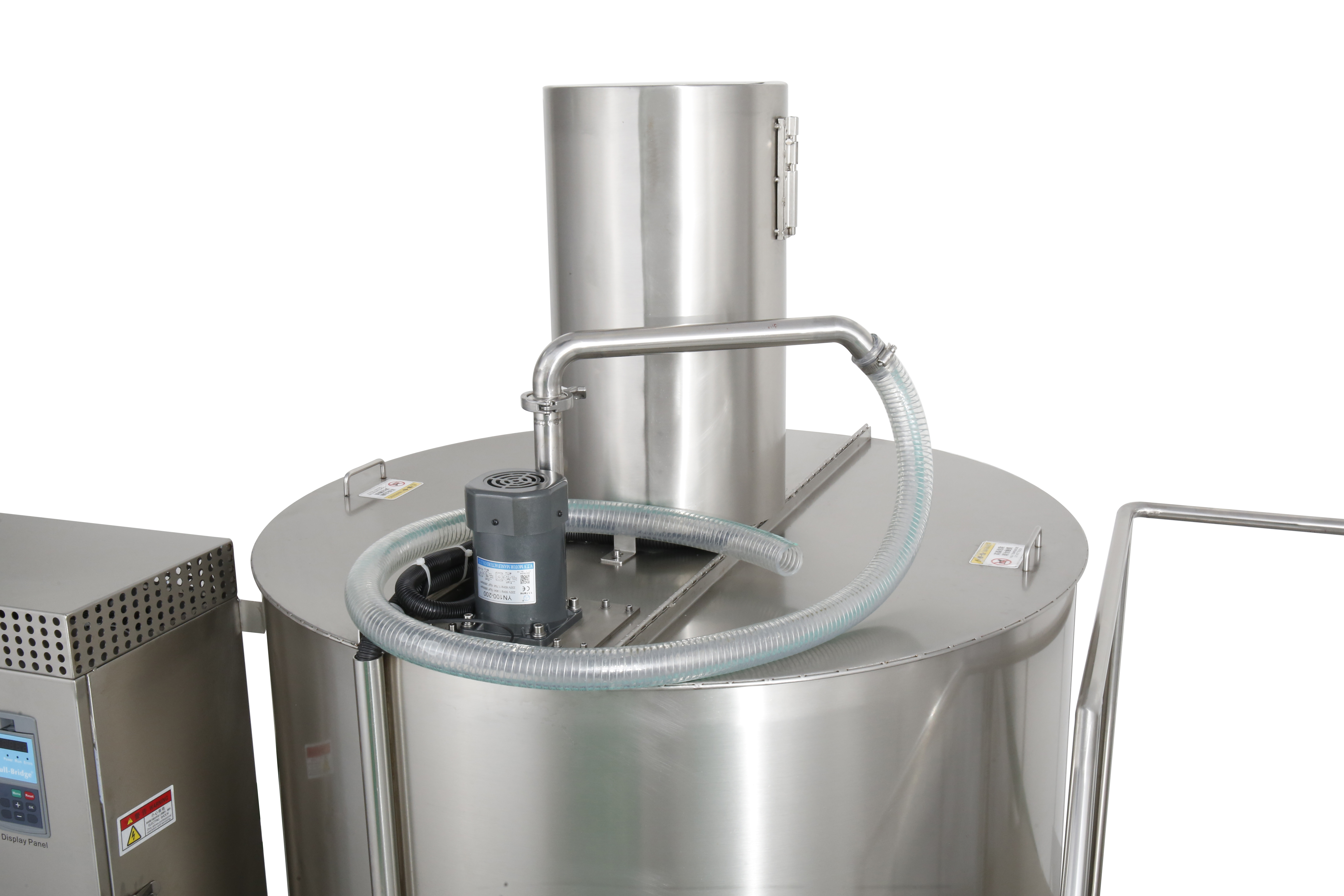
Many suppliers attempt to sell oversized electric pots as industrial equipment. True industrial systems utilize entirely different heating architectures. Direct heating mechanisms are completely unacceptable for large volumes. You cannot simply scale up a basic heating element and expect uniform results. High-capacity systems require jacketed heating. They use circulating water or thermal oil to distribute heat indirectly. This uniform distribution prevents localized scorching effectively. It protects fragile fragrance flashpoints during long operational shifts. Direct heat often degrades wax viscosity, ruining pour quality over time.
Tank insulation remains a frequently ignored factor in procurement. Fully insulated walls are mandatory at the 1000L scale. Poorly insulated tanks radiate massive amounts of heat into your facility. High-quality insulation prevents this ambient heat loss entirely. It reduces daily energy consumption by up to 50 percent. Insulation also stabilizes internal temperatures against cold drafts in warehouse environments.
Material specifications directly impact product purity and maintenance schedules. You must mandate 304 or 316 food-grade stainless steel construction. Interiors must feature seamless designs or flawlessly polished welds. Flawless welds provide essential non-stick capabilities. They prevent cross-contamination between different raw materials. Soy, paraffin, and coconut blends behave differently under heat. Leftover residue from a previous batch ruins subsequent pours easily.
Review this comparison chart to understand why architecture matters:
Feature Category
Direct Heating (Oversized Pots)
Jacketed Heating (Industrial Grade)
Heat Distribution
Uneven; creates severe hot spots near elements.
Highly uniform; heat transfers through fluid jacket.
Material Safety
High risk of scorching and fragrance degradation.
Protects delicate flashpoints and maintains viscosity.
Energy Efficiency
Poor; loses heat rapidly without thick insulation.
Excellent; typically features dual-wall insulated layers.
Cleanability
Often features exposed elements or rough seams.
Seamless stainless steel promotes easy wipe-downs.
Key Evaluation Dimensions for 1000L Wax Processing Systems
A massive 1000L melter provides zero value without highly efficient extraction mechanisms. You must evaluate dispensing technology and pump integration carefully. Look specifically for heated, stainless-steel gear pumps. They should pair exclusively with braided Teflon-core hoses. These components maintain the material in a liquid state constantly. They prevent sudden clogging during critical pouring phases.
Precision temperature control requires much more than basic digital dials. You need sophisticated PLC controllers governing the system. They must hold large liquid volumes within a tight ±5°C threshold. You should ensure heating elements feature reliable auto-shutoff sensors. These sensors automatically kill power if jacket fluid drops too low. This simple feature prevents catastrophic electrical fires and element burnout.
Drainage engineering separates excellent machines from mediocre alternatives. Evaluate the tank floor geometry thoroughly before purchasing. We strongly recommend conical or center-drain bottom designs. They guarantee 98% material extraction naturally. Your staff will not need manual tilting or scraping tools. This facilitates much faster batch changeovers between different scents.
Agitation mechanisms remain optional for small pots but are highly recommended for deep tanks. Deep 1000L tanks suffer from natural temperature stratification. The top layer cools while the bottom overheats. Variable-speed, top-mounted stirrers prevent this issue entirely. They keep the temperature completely uniform from top to bottom.
Follow these numbered steps when evaluating a new system:
Verify the pump type: Confirm it utilizes stainless-steel gears rather than cheap plastic impellers.
Check the PLC rating: Ensure the controller supports custom heating curves and holds temperatures precisely.
Inspect the floor geometry: Reject flat-bottom tanks; demand sloped or conical bases for gravity-assisted drainage.
Test the agitation speed: Ensure the stirrer motor offers variable speeds to handle different wax viscosities smoothly.
Implementation Realities: Safety, Compliance, and Workflow Integration
Installing a high-wattage melter involves serious facility preparations. You must address electrical realities immediately. These heavy-duty machines generally require dedicated three-phase power. Standard warehouse outlets will not support their amperage draw. Your concrete floors must possess adequate load-bearing capacity to support tons of liquid weight. You will also need proper industrial ventilation to manage jacket fluid exhaust safely.
Safety certifications act as a non-negotiable barrier to entry. Your equipment must meet strict international safety standards to pass insurance audits. Look specifically for UL, CSA, or CE certifications on the manufacturer's plate. Machines must include integrated safety mechanisms at every level. Emergency stop buttons are absolutely mandatory. Anti-boil-dry sensors prevent the heating jacket from running empty. Lockable control panels keep unauthorized staff from altering delicate temperature recipes.
You must assess changeover speeds and cleaning protocols. Consider the operational friction of switching blends during daily wax processing. Advanced systems support clean-in-place (CIP) methodologies. Internal layouts should feature zero blind spots or hard angles. This streamlined design prevents cross-batch contamination entirely. Fast cleaning protocols keep your production line moving.
Common Mistake: Failing to calculate the total operating weight of the equipment. A 1000L machine filled with material and jacket fluid weighs significantly more than the empty steel chassis.
Facility Requirement
Specification to Verify
Why It Matters
Electrical Supply
Three-phase power, 220V/380V+.
Prevents tripped breakers and supports high-draw heating elements.
Floor Load Bearing
Minimum 2,500+ lbs per square meter.
Supports the combined weight of the steel tank, fluid jacket, and full wax load.
Ventilation
Overhead exhaust hoods or direct venting.
Removes thermal oil fumes or steam safely from the operator workspace.
Clearance Space
3 feet minimum around all sides.
Allows maintenance access to pumps, valves, and the PLC control box.
Building the Business Case and Vendor Shortlisting Logic
You must shift your procurement focus from the initial purchase price to long-term operational cost savings. A higher upfront cost for premium equipment often yields drastically reduced scrap rates. Fully insulated tanks lower your monthly energy bills significantly. Automated PLC features reduce wasted labor hours spent manually checking thermometers. These compound operational savings justify the initial equipment investment very quickly.
Evaluating B2B suppliers requires a highly skeptical buyer's checklist. Do not accept generic, copy-pasted spec sheets from any manufacturer. Demand detailed component sourcing information upfront. Ask explicitly who manufactures the internal pump and the drive motor. You should require documented Machinery Test Reports before sending any payment. Always ask for comprehensive video outgoing-inspections prior to shipment. A reputable vendor will gladly demonstrate the machine holding precise temperatures on video.
Your immediate next steps involve internal operational audits. Advise your engineering team to audit your current electrical infrastructure today. Map out your projected 12-month production volume clearly. Do this intensive preparation before you request custom quotes from vendors. This internal clarity prevents costly installation surprises and ensures you buy the exact capacity you need.
Conclusion
Upgrading to a 1000L tank fundamentally transforms your business workflow. It transitions manual pouring routines into a highly controlled, predictable manufacturing operation. You eliminate the chaos of managing dozens of small pots.
Prioritize thermal consistency by demanding jacketed heating and thick wall insulation.
Ensure efficient drainage by selecting conical tank bottoms and heated gear pumps.
Demand industrial-grade components like advanced PLCs and certified safety sensors.
Audit your facility's electrical and structural capacity before signing purchase orders.
By strictly adhering to these evaluation dimensions, you protect your capital investment. Focus on structural integrity and proven performance metrics. This disciplined approach is the only way to guarantee a rapid ROI in candle production.
FAQ
Q: How long does it take a 1000L wax melter to reach optimal pouring temperature?
A: Heating times depend heavily on the machine's kilowatt rating and jacket fluid. A standard high-wattage industrial melter typically takes 3 to 5 hours to melt a full 1000L batch from a cold solid state. Starting with partially warmed material or leaving the system on a low-hold temperature overnight reduces this cycle time significantly.
Q: Can I melt different types of wax (soy, paraffin, beeswax) in the same large-capacity machine?
A: You can, but we strongly advise against it for high-volume operations. Switching between soy, paraffin, and beeswax requires intensive, time-consuming cleaning cycles to prevent cross-contamination. Leftover residue alters the melting points and burn characteristics of subsequent batches. Most successful factories dedicate separate machines to distinct blends.
Q: What flow rate should I expect from an industrial wax pump?
A: A high-quality gear pump should deliver a benchmark flow rate of 1 to 1.5 gallons per minute. Actual throughput varies based on the specific material viscosity, pouring temperature, and the diameter of your heated hoses. Variable-speed pumps allow you to throttle this rate for smaller container vessels.
Q: Does a 1000L tank require structural floor reinforcement?
A: Yes, in many standard commercial spaces. You must account for the empty weight of the steel chassis, plus roughly 2,000 pounds of liquid wax, and the heavy fluid filling the heating jacket. Always consult a structural engineer to verify your floor's load-bearing capacity before installation.