- Home
-
-
How An Industrial Wax Melting Machine Improves Large-Scale Wax Processing
Views: 0 Author: Site Editor Publish Time: 2026-05-08 Origin: Site


Can a factory process large volumes of wax efficiently if melting is still slow, uneven, and hard to control? In large-scale wax processing, wax melting directly affects production speed, material quality, labor cost, energy use, and final product consistency.
An industrial wax melting machine helps solve these problems by increasing batch capacity, improving temperature control, reducing manual handling, and creating more uniform wax melting.
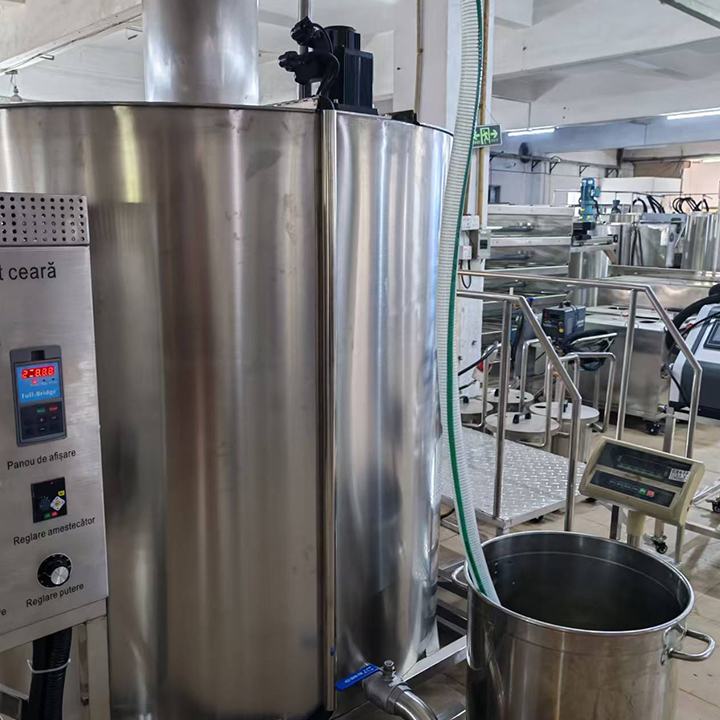
In this post, you’ll learn how an industrial wax melting machine improves large-scale wax processing through faster melting, stable temperature, lower waste, safer operation, and smoother production workflow.
What Is an industrial wax melting machine?
An industrial wax melting machine is heavy-duty equipment used to melt, heat, hold, mix, and discharge large volumes of wax. It is built for factories and commercial production environments where wax needs to be processed repeatedly, safely, and efficiently.
Unlike small wax pots or simple wax melters, an industrial wax melting machine is designed for higher capacity, longer working hours, stronger heating performance, and more stable temperature control. It is commonly used in candle manufacturing, wax block processing, paraffin wax processing, beeswax processing, cosmetic wax production, wax coating, packaging wax processing, and other wax-based production lines.
A typical industrial wax melting machine may include:
● Stainless steel melting tank
● Electric, thermal oil, water jacket, or steam heating system
● Digital temperature controller
● Agitator or mixing system
● Insulation layer
● Discharge valve
● Pump connection
● Control panel
● Safety protection system
● Custom tank or production line connection
For some medium-to-large production projects, a commercial wax melting machine can also be used as part of industrial wax processing. The key difference is that an industrial wax melting machine is usually designed for larger volume, stronger durability, and better integration with downstream equipment.
Why Large-Scale Wax Processing Needs Better Melting Equipment
Large-scale wax processing is very different from small-batch wax melting. When the processing volume increases, small inefficiencies become major production problems.
For example, if a small workshop wastes 1 kg of wax per day, the loss may be manageable. But if a large factory wastes 20 kg or 50 kg of wax per day because of poor melting, residue, spills, or failed batches, the cost becomes significant. The same is true for labor time, heating time, and temperature variation.
Large-scale wax processing needs equipment that can solve these common problems:
● Limited batch capacity
● Slow wax melting speed
● Uneven heat distribution
● Difficult temperature control
● Poor wax flow
● High manual labor demand
● Wax residue and waste
● Inconsistent batch quality
● Unsafe hot wax handling
● Poor connection with filling or production lines
An industrial wax melting machine improves the process by making wax melting more controlled, scalable, and repeatable. Instead of relying on many small containers or manual heating methods, factories can use one properly designed machine to manage large-volume wax preparation.
It Increases Wax Processing Capacity
The first major improvement is capacity. Large-scale wax processing requires large wax batches. A small wax melter may work for sample production, but it cannot support daily industrial output.
An industrial wax melting machine allows manufacturers to process larger wax volumes in one cycle. This reduces repeated loading, reheating, waiting, and transferring. For factories that need steady wax supply throughout the day, higher capacity is essential.
For example, if a candle factory produces 5,000 candles per day and each candle requires 200 grams of wax, the factory needs about 1,000 kg of wax daily. Processing this amount with small wax melters would require many repeated batches. An industrial wax melting machine can reduce the number of melting cycles and help maintain a more stable production flow.
Production Need
Approximate Wax Demand
Equipment Requirement
Small batch production
20 kg–100 kg per day
Small or medium wax melter
Growing commercial production
100 kg–500 kg per day
Commercial wax melting machine
Large-scale wax processing
500 kg–1500 kg per day
Industrial wax melting machine
High-volume factory production
1500 kg+ per day
Custom industrial wax melting system
Higher capacity does not only mean a larger tank. It also means the machine must heat efficiently, hold temperature properly, discharge wax smoothly, and fit the factory’s production schedule. A large tank without good heating or discharge design will still create bottlenecks.
It Improves Melting Speed
Melting speed is one of the most important factors in large-scale wax processing. If wax melting is too slow, every later step becomes delayed. Filling, molding, coating, blending, packaging, and cooling all depend on melted wax being ready at the right time.
An industrial wax melting machine improves melting speed through stronger heating power and better heat transfer design. Depending on the application, the machine may use direct electric heating, oil-jacketed heating, water-jacketed heating, or steam heating.
The best heating method depends on the wax type and production goal. For example, paraffin wax may require a different heating strategy from soy wax, beeswax, or cosmetic wax blends. A suitable heating system helps melt wax faster while avoiding overheating or burning.
Faster melting helps large-scale wax processing by:
● Reducing batch preparation time
● Increasing daily output
● Improving equipment utilization
● Reducing waiting time between production steps
● Supporting faster order fulfillment
● Making production scheduling easier
However, faster melting should not mean uncontrolled heating. An industrial wax melting machine should melt wax efficiently while protecting wax quality. This balance is especially important when processing wax with fragrance, color, additives, or special formulas.
It Stabilizes Temperature Control
Temperature control is central to large-scale wax processing. Wax changes behavior at different temperatures. Temperature affects melting speed, viscosity, flow rate, additive mixing, fragrance performance, color dispersion, filling accuracy, and final product appearance.
Manual or small-batch heating often creates temperature variation. One container may be too hot, another may be too cool, and the operator may need to check temperatures repeatedly. This becomes difficult when processing large volumes of wax.
An industrial wax melting machine helps stabilize temperature by using a controlled heating system and temperature controller. Operators can set the required temperature range and keep wax within a more stable processing window.
Stable temperature control improves:
● Wax viscosity
● Melting consistency
● Additive blending
● Fragrance mixing
● Color uniformity
● Discharge flow
● Filling performance
● Batch repeatability
For candle manufacturers, stable wax temperature can reduce rough tops, weak scent throw, uneven color, sinkholes, and poor container adhesion. For wax coating or packaging applications, stable temperature helps maintain consistent wax flow and coating performance.
In large-scale wax processing, stable temperature is not only a quality factor. It is also a production efficiency factor. When temperature is controlled, operators spend less time correcting problems and more time running production.
It Creates More Uniform Wax Melting
Uniform melting becomes harder as tank size increases. In a large tank, wax near the heating surface can melt quickly, while wax in the center or upper area may remain solid for longer. If the machine is poorly designed, this can cause hot spots, burned wax, unmelted wax blocks, and inconsistent viscosity.
An industrial wax melting machine can improve wax uniformity through better heating structure and mixing design. Jacketed heating can distribute heat around the tank more evenly. An agitator or mixing system can move wax inside the tank and reduce temperature differences.
Uniform wax melting is important because it helps prevent:
● Burned wax near the heating surface
● Unmelted wax in the tank
● Uneven viscosity
● Poor additive distribution
● Color differences
● Fragrance inconsistency
● Irregular filling or coating behavior
For large-scale wax processing, uniform wax quality is essential. If the wax is not consistent inside the tank, the final product will not be consistent either. An industrial wax melting machine helps create a more stable material foundation before wax enters the next production step.
It Supports Mixing and Additive Distribution
Many wax processing applications require more than melting. Wax may need to be mixed with fragrance oil, dye, pigments, hardeners, softeners, oils, polymers, or other additives. If these materials are not distributed evenly, the finished product may have quality problems.
An industrial wax melting machine with an agitator can improve mixing. The mixing system helps distribute heat, blend additives, and maintain wax uniformity during processing.
This is especially useful for:
● Scented candle wax
● Colored candle wax
● Cosmetic wax formulas
● Wax blends
● Industrial coating wax
● Packaging wax
● Functional wax products
For example, in candle production, fragrance oil must be mixed at the correct temperature and distributed evenly throughout the wax. In cosmetic wax processing, texture and ingredient consistency are important. In coating applications, wax viscosity and additive distribution affect coating quality.
A commercial wax melting machine with a mixing function may be enough for medium-scale production. For larger factories, a custom industrial wax melting machine with a stronger agitator may be more suitable.
It Improves Discharge and Wax Transfer
After wax is melted, it must be discharged or transferred to the next step. This may include pouring, pumping, filling, molding, coating, or storage. Poor discharge design can slow down production and increase wax waste.
An industrial wax melting machine usually includes a discharge valve designed for hot wax flow. Some systems can also connect with pumps, pipelines, filling machines, or storage tanks.
Good discharge design helps improve:
● Wax flow control
● Filling efficiency
● Transfer speed
● Material use
● Cleaning convenience
● Operator safety
● Production continuity
If the discharge valve is too small, wax may flow too slowly. If the valve is poorly positioned, too much wax may remain in the tank. If the valve is difficult to clean, residue may build up and affect future batches.
In large-scale wax processing, discharge design is just as important as heating design. A machine that melts wax quickly but discharges poorly will still limit production efficiency.
It Reduces Manual Labor
Manual labor becomes a major problem in large-scale wax processing. Workers may need to load wax repeatedly, monitor multiple pots, stir wax manually, carry hot containers, check temperature, and clean several small vessels.
An industrial wax melting machine reduces much of this manual work. Larger batches can be processed in one tank. Temperature can be controlled more easily. Wax can be discharged through a valve or transferred by pump.
This reduces:
● Repeated wax loading
● Manual stirring
● Manual temperature checking
● Heavy lifting
● Hot wax transfer
● Operator fatigue
● Labor time per batch
Reducing labor does not only lower cost. It also improves production stability. When fewer steps depend on manual handling, there is less chance of human error, spills, burns, or inconsistent processing.
For factories, labor efficiency is closely connected to production capacity. An industrial wax melting machine allows workers to focus more on quality control, filling, packaging, maintenance, and production management instead of spending too much time on basic wax melting.
It Helps Reduce Wax Waste
Wax waste becomes more serious when processing large volumes. Waste can come from spills, overheating, poor discharge, residue in tanks, blocked valves, failed batches, or inaccurate temperature control.
An industrial wax melting machine helps reduce waste by improving process control. Stable temperature reduces the risk of overheating or failed batches. A smooth tank and discharge structure help reduce leftover wax. Better melting uniformity reduces the chance of unusable material.
Common sources of wax waste include:
Waste Source
Cause
How an Industrial Wax Melting Machine Helps
Spills during transfer
Manual carrying and pouring
Controlled valve or pump discharge
Wax residue
Poor tank or valve design
Smoother tank and better discharge layout
Failed batches
Unstable temperature
More accurate temperature control
Burned wax
Hot spots or overheating
Better heating distribution
Blocked flow
Wax cooling in valves or pipes
Temperature holding and proper discharge design
In large-scale processing, even small percentage savings can be valuable. Reducing wax waste helps lower material cost, improve production cleanliness, and increase overall efficiency.
It Improves Batch Consistency
Batch consistency is one of the main goals of large-scale wax processing. Whether the factory produces candles, wax blocks, cosmetic wax products, coating wax, or packaging wax, customers expect the same quality from batch to batch.
An industrial wax melting machine improves batch consistency by controlling key processing conditions, including temperature, melting time, mixing, holding time, and discharge flow.
Consistent processing helps keep each batch stable in:
● Texture
● Viscosity
● Color
● Fragrance distribution
● Additive distribution
● Filling behavior
● Cooling behavior
● Final appearance
For manufacturers, consistent batches reduce rework, complaints, material loss, and production delays. This is especially important for OEM production, private-label manufacturing, and repeat commercial orders.
A commercial wax melting machine may support consistency for medium-volume production, while an industrial wax melting machine is more suitable when batch size, output, and quality requirements increase.
It Supports Continuous or Semi-Continuous Production
Large-scale wax processing often requires continuous or semi-continuous workflow. Wax may need to be melted, held, mixed, transferred, and filled throughout the working day.
An industrial wax melting machine can support this workflow by holding melted wax at a stable temperature and supplying wax to downstream equipment when needed.
It can be connected with:
● Wax pumps
● Filling machines
● Storage tanks
● Mixing tanks
● Molding lines
● Coating machines
● Conveyors
● Cooling tables
This connection improves production continuity. Instead of stopping production to wait for wax, the factory can keep wax ready for the next step. This is especially useful for large candle lines, wax block molding, cosmetic wax filling, and coating applications.
Continuous production requires stable material supply. An industrial wax melting machine helps provide that supply.
It Improves Production Safety
Large-volume hot wax processing requires strong safety control. Manual heating and transferring can increase the risk of burns, spills, overheating, and electrical problems.
An industrial wax melting machine improves safety by creating a more controlled processing environment. The wax is held inside a designed tank, temperature is controlled by the system, and discharge can be managed through valves or pumps.
Important safety features may include:
● Overheat protection
● Temperature limiter
● Emergency stop button
● Insulated tank wall
● Stable machine frame
● Safe electrical system
● Grounding protection
● Heat-resistant handles
● Anti-leak discharge valve
● Clear control panel
Safety is not separate from efficiency. A safer wax processing system reduces accidents, emergency shutdowns, equipment damage, and operator stress. For large-scale production, safety design should be considered a core part of the machine’s value.
It Improves Energy Use and Heat Retention
Large-scale wax processing can consume significant energy. If the machine loses heat quickly or uses inefficient heating, operating costs increase.
An industrial wax melting machine can improve energy use through better insulation, proper heating power, and accurate temperature control. Once the wax reaches the target temperature, the machine can help maintain heat instead of constantly reheating from a lower temperature.
Better heat retention helps:
● Reduce energy waste
● Maintain stable wax temperature
● Shorten reheating time
● Improve production scheduling
● Support long working hours
● Lower operating cost
For factories that process wax every day, energy efficiency can have a meaningful long-term impact. A well-designed industrial wax melting machine should not only melt wax quickly but also hold temperature efficiently.
Manual Melting vs industrial wax melting machine
Comparison Point
Manual or Small-Batch Melting
Industrial Wax Melting Machine
Batch capacity
Small and limited
Large and scalable
Melting speed
Slow and repetitive
Faster and more efficient
Temperature control
Difficult to maintain
More accurate and stable
Wax uniformity
Uneven and operator-dependent
More consistent with proper heating and mixing
Labor requirement
High manual workload
Lower operator workload
Wax waste
Higher risk of spills and residue
Better material control
Discharge method
Manual pouring
Valve, pump, or line connection
Production continuity
Limited
Supports continuous or semi-continuous production
Safety
More hot wax handling
More controlled operation
This comparison shows why an industrial wax melting machine is important for large-scale wax processing. It improves not only melting speed, but also the whole wax preparation and transfer process.
How to Choose the Right industrial wax melting machine
To improve large-scale wax processing, the machine must match the actual production process. Choosing a machine only by price or tank size can create new problems.
Before selecting an industrial wax melting machine, consider:
● Daily wax processing volume
● Wax type and melting point
● Batch size
● Heating method
● Temperature control accuracy
● Need for mixing or agitation
● Tank material
● Insulation design
● Discharge valve size and position
● Pump or filling machine connection
● Cleaning requirements
● Safety features
● Voltage and power supply
● Available factory space
● Future production growth
The right machine should make the process easier, not more complicated. It should melt wax efficiently, hold temperature steadily, discharge smoothly, and fit the factory workflow.
Conclusion
An industrial wax melting machine improves large-scale wax processing by increasing capacity, speeding up wax melting, stabilizing temperature control, improving wax uniformity, reducing manual labor, lowering wax waste, improving safety, and supporting continuous or semi-continuous production.
For factories that process large volumes of wax, the melting machine is not just a heating tank. It is a key part of the production system. The right industrial wax melting machine helps make wax processing more efficient, stable, scalable, and easier to control.
If your factory needs larger wax batches, better temperature stability, smoother discharge, safer operation, and more consistent wax quality, Dongguan Yide Machinery Co., Ltd. can provide reliable industrial wax melting machine solutions to support large-scale wax processing performance.
FAQs
1. What is an industrial wax melting machine used for?
An industrial wax melting machine is used to melt, heat, hold, mix, and discharge large volumes of wax for candle manufacturing, wax processing, cosmetic wax production, wax coating, packaging wax applications, and other large-scale wax processing needs.
2. How does an industrial wax melting machine improve large-scale wax processing?
It improves large-scale wax processing by increasing batch capacity, speeding up melting, stabilizing temperature control, improving wax uniformity, reducing labor, lowering wax waste, improving safety, and supporting continuous production.
3. What types of wax can an industrial wax melting machine process?
An industrial wax melting machine can process paraffin wax, soy wax, beeswax, coconut wax, palm wax, microcrystalline wax, gel wax, blended wax, and other industrial wax materials, depending on machine design and temperature range.
4. Is a commercial wax melting machine suitable for industrial wax processing?
A commercial wax melting machine can be suitable for medium-to-large wax processing when it has enough capacity, stable heating, accurate temperature control, reliable discharge design, and proper safety features. For higher output, a customized industrial wax melting machine may be more suitable.
5. How do I choose the right industrial wax melting machine?
Choose based on daily wax volume, wax type, batch size, heating method, temperature control accuracy, mixing needs, tank material, discharge design, cleaning convenience, safety features, and manufacturer support.