Views: 0 Author: Site Editor Publish Time: 2026-11-15 Origin: Site


Producing premium candles requires more than just pouring perfect wax and selecting the finest fragrances. Behind the scenes, bottom labeling remains a critical yet frequently overlooked bottleneck in many manufacturing lines. Mandatory regulatory elements, including UK/EU CLP warnings, UPC barcodes, and safety instructions, must sit squarely and securely on the jar base. Relying on manual application introduces substantial hidden costs to your operation. Operators consistently struggle with uneven placement, unsightly bubbles forming over raised wick tabs, and a severe labor drain during peak production seasons. Transitioning to specialized automated equipment presents a highly logical step for scaling your production capacity. By standardizing your packaging aesthetics, you can confidently meet strict retail compliance standards without sacrificing your profit margins. This comprehensive guide explores the mechanical solutions, sizing rules, and setup realities required to optimize your packaging process.
Upgrading to a dedicated bottom labeling machine standardizes safety compliance and eliminates the labor bottleneck associated with manual application.
Selecting the right equipment requires evaluating jar base types (flat vs. recessed) and production volume to choose between semi-automatic and fully automatic systems.
Label material (heat/oil resistance) and accurate sizing are just as critical as the machine itself to ensure long-term adhesion and brand integrity.
Successful implementation relies on precise sensor calibration and understanding the limitations of applying labels over uneven surfaces like wick tabs.
Candle makers often treat the bottom label as an afterthought. However, retailers and regulatory bodies view it as the most important part of your packaging. Upgrading to a Bottom Labeling Machine fundamentally changes how you manage compliance and throughput on your production floor.
You cannot sell a candle legally in most major markets without specific safety warnings. In the UK and EU, Classification, Labelling and Packaging (CLP) regulations dictate exact text and pictogram sizes. In the US, ASTM safety standards require specific fire hazard warnings. Furthermore, big-box retailers demand scannable UPC barcodes and clear batch tracking numbers. If operators apply these labels manually, they often skew them or place them off-center. Retail compliance teams will reject entire shipments if barcodes scan poorly or safety text wraps around the jar's bottom edge.
Consider the raw mathematics of manual application. A skilled worker might apply 10 to 15 bottom labels per minute. They experience fatigue, and their accuracy drops significantly after the first hour. When you introduce mechanical application, throughput scales dramatically. Machines easily apply 60 to 150 labels per minute depending on the model. This shift frees your team to focus on quality control and order fulfillment. You typically see a rapid return on investment (ROI) based purely on labor savings and reduced rework.
Manual application creates a high rate of defective products. Thumbs press unevenly, trapping air under the sticker. Mechanical application eliminates these common errors. Applicator pads or brushes apply uniform pressure across the entire surface. This prevents off-center placement, wrinkling, and edge peeling. Ultimately, a perfectly centered, smooth bottom label reinforces the premium brand perception you work so hard to build.
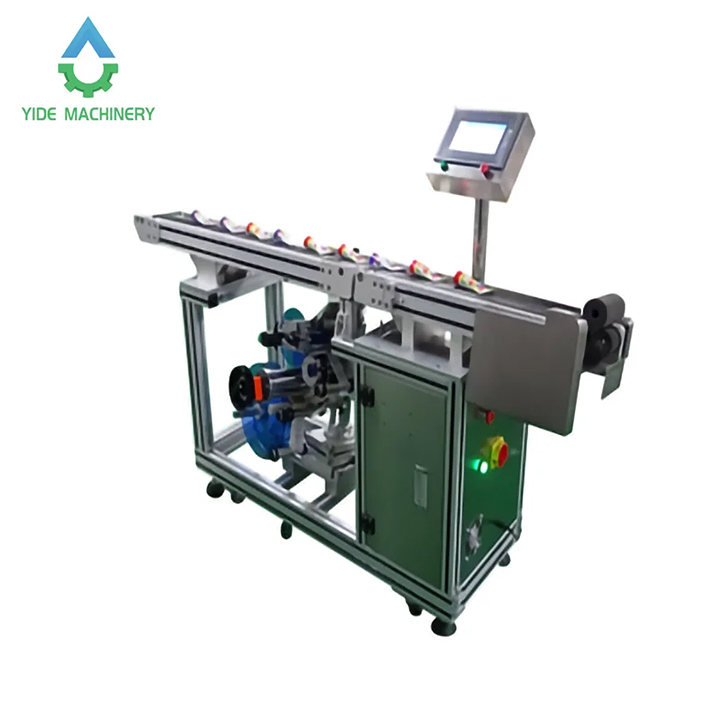
Finding the right Candle Jar Labeling Machine depends entirely on your production environment. These machines apply labels to the underside of a container. They either move the jar along a conveyor or hold it in a specialized jig. Let us explore the two main categories.
A Semi-Automatic Bottom Labeling Machine requires operator assistance. A worker places the candle into a custom fixture or jig. They press a foot pedal, and the machine tamps or wipes the label onto the base.
Target Profile: These units are ideal for growing artisanal brands, medium-batch runs, and facilities with frequent container changeovers.
Capabilities: They rely on precise fixtures to center the jar perfectly every time. They represent a lower upfront capital requirement while still guaranteeing accurate placement. You can quickly swap jigs when moving from a travel tin to a large glass tumbler.
An Automatic Bottom Labeler operates without direct human intervention. Jars travel down a conveyor belt, and the machine dispenses the label upward onto the base as they pass.
Target Profile: Manufacturers build these for high-speed, inline production facilities. If you produce thousands of units daily, you need this automation level.
Capabilities: They integrate directly into existing conveyor lines. They feature continuous feed mechanisms and split-belt systems. A split-belt system grips the sides of the jar, leaving the bottom exposed for the applicator. Automatic synchronization ensures high-volume output perfectly matches your conveyor speed.
Applying a sticker to a flat box is easy. Applying one to a candle jar introduces unique physical challenges. You must evaluate equipment based on how it handles these specific obstacles.
Glass candle jars rarely feature perfectly flat bases. Manufacturers mold them with deep punts or recessed bottoms. Standard wipe-on applicators fail here because they cannot reach inside the recess. You must evaluate machines based on their applicator pad stroke depth. Specialized tamp-blow mechanisms push the label down into the recess. A burst of air then presses the edges securely against the glass. Always measure the depth of your deepest jar punt before purchasing equipment.
You face a physical reality at the center of every jar: the wick tab. This metal disc, held by glue or stickum, creates a distinct bump right where you want to place your label. If an applicator pad applies rigid pressure, the label will wrinkle terribly over the metal tab. Assess how the applicator manages pressure. The best machines use soft, conforming sponge pads or specialized bristle brushes. These materials absorb the shape of the tab and distribute pressure evenly across the rest of the glass.
Machines rely on sensors to know exactly when to dispense a label. They read the gap between individual stickers on the liner roll. High-quality photoelectric sensors handle standard paper stickers easily. However, many candle brands use clear BOPP (Biaxially Oriented Polypropylene) or highly reflective metallic stocks. Standard sensors cannot detect gaps between clear materials.
Follow these steps for reliable sensor setup:
Identify your label material (opaque vs. clear).
Install a capacitive or ultrasonic sensor if running clear BOPP.
Thread the web smoothly to maintain consistent tension.
Run a slow-speed test to verify the sensor registers every single gap without misfiring.
For automatic lines, stability dictates accuracy. A glass jar moving on a conveyor can easily spin or shift. When the dispensing edge hits the jar base, any movement results in a crooked label. Explain this necessity to your line operators: you must use top-hold down belts or side-hugging belts. These belts grip the jar firmly. They lock the container in place during the exact millisecond of label application.
The best machine in the world will fail if you feed it the wrong materials. Candle environments are harsh. Labels must survive heat, oil, and handling.
Determining your label dimensions requires careful measurement. You must fit all legal text without wrapping the label up the curved edges of the jar base. Emphasize leaving a minimum 1/8-inch tolerance around the perimeter. This margin prevents edge peeling over time.
Container Type / Volume | Base Diameter (Approx) | Recommended Label Diameter |
|---|---|---|
4 oz Travel Tin | 2.25 inches | 1.75 to 2.0 inches |
8 oz Standard Glass Jar | 2.75 inches | 2.0 to 2.5 inches |
16 oz Glass Tumbler | 3.50 inches | 2.75 to 3.25 inches |
3-Wick Wide Bowl | 4.00+ inches | 3.25 to 3.75 inches |
Evaluate substrates carefully against the realities of candle usage. Paper looks natural but absorbs oils instantly. Vinyl offers durability but can stretch during machine application. BOPP remains the industry standard. It resists moisture, handles mechanical tension beautifully, and blocks fragrance oils from ruining your ink.
Labels must withstand radiant heat. As the candle burns down, the burn pool generates significant temperatures at the base. Cheap materials will scorch, discolor, or simply fall off. Always test your chosen substrate by burning a candle completely to the bottom.
Your adhesive must bond instantly to glass or tin. We call this "high initial tack." Candles often sit in humid warehouses or experience severe temperature fluctuations during winter shipping. Discuss your requirements with your printer. You need an aggressive, high-tack adhesive formulated for cold and warm extremes. If the adhesive creeps or loosens, your safety warnings disappear, leaving you legally exposed.
Bringing new machinery onto your floor requires preparation. You must manage changeovers, train your team, and control material waste.
Assess the time and tooling required to switch your machine. Moving from a small travel tin to a large 3-wick glass tumbler changes everything. For semi-automatic units, you swap the holding jig and adjust the sensor delay. This takes about five minutes. For automatic lines, you must adjust guide rails, widen split belts, and recalibrate sensor heights. Measure a machine's value by how quickly operators can complete these changeovers without using specialized hand tools.
Acknowledge a simple fact: while machines reduce manual labor, they introduce new technical demands. They require proper training. Operators must learn proper web threading. If they thread the liner backward, the machine jams. They must master tension adjustment. Too loose, and labels dispense early; too tight, and the backing paper snaps. Sensor tuning takes practice. Invest time in training your lead operators so they become internal experts.
Expect label waste during the initial calibration phase. When dialing in placement over a recessed punt, you will sacrifice some labels. You must establish standard operating procedures (SOPs) to minimize material loss during roll changes. Instruct operators to save misaligned jars. They can scrape the base clean and re-run them. Proper SOPs turn a frustrating learning curve into a predictable, manageable process.
Selecting a bottom labeler is fundamentally an exercise in balancing your current container specifications with your projected production volumes. You must map your jar recesses, measure your wick tab heights, and calculate your daily output needs. By understanding the interplay between machine mechanics, sensor technology, and label material science, you protect your brand's compliance and visual appeal. Before signing a purchase order, always request a manufacturer video trial. Send them your specific candle jars and a roll of your actual label stock. Verify placement accuracy and speed on camera. This simple step eliminates assumptions and guarantees successful procurement.
A: No. Bottom labeling requires specialized split-conveyor belts or specific tamp-down applicators that access the underside of the product. Wrap-around systems operate on a completely different vertical axis and cannot reach beneath the container.
A: The machine must be equipped with a specialized capacitive or ultrasonic clear label sensor. Standard photoelectric sensors rely on opacity and cannot consistently detect the gap between a clear label and its liner.
A: While jar dimensions vary by manufacturer, a standard 8 oz jar typically accommodates a bottom label between 1.5 and 2 inches in diameter. Always measure the flat, printable area of the recess, subtracting a slight margin to avoid the curved edges.
A: Yes, provided the machine uses a soft, conforming sponge or brush applicator that distributes pressure evenly across the uneven surface created by the wick stickum and metal tab.