Views: 0 Author: Site Editor Publish Time: 2026-11-13 Origin: Site


Transitioning from artisanal, small-batch candle making to high-volume production introduces critical bottlenecks in consistency, labor costs, and quality control. Every production manager knows the growing pains of scaling up operations. While the fundamental physics of making pillar candles—melting, molding, cooling, and demolding—remain the same, the methodology shifts drastically when scaling. Manual pouring yields aesthetic variability. Mechanical automation demands precision engineering.
You need exacting control over temperatures and cycle times to stay competitive. This guide breaks down the commercial pillar candle manufacturing process, contrasting manual techniques against the capabilities of industrial equipment. You will learn how modern machinery prevents common defects, accelerates output, and protects your margins. We designed this breakdown to help production managers evaluate exactly when and how to automate their manufacturing floor.
Standardization is the primary ROI driver: Moving from manual pouring to a Pillar Candle Machine eliminates weight variations and reduces raw material waste.
Wax formulation dictates equipment needs: Paraffin and soy blends shrink and cool differently, requiring specific temperature control systems and tailored Soy Wax Pillar Candle Equipment.
Cooling dictates throughput: Controlled water-cooling systems in automated machines reduce cycle times by up to 70% compared to ambient air cooling.
Automated demolding protects margins: Mechanical ejection prevents the surface defects and breakages common in manual mold extraction.
Scaling a candle business quickly exposes the operational limits of manual production. Artisanal methods work beautifully for boutique batches. However, they struggle under the weight of high-volume commercial demands. Hidden costs drain profitability long before you notice them on a balance sheet.
Manual pouring relies heavily on human consistency. This introduces uncontrollable variables into your daily output. Operators face inconsistent pour temperatures, resulting in poor mold adhesion or visible surface flaws. You also accumulate high labor hours per unit because workers must wick, pour, monitor, and demold every individual candle.
Common unpredictable defect rates plague manual setups:
Sinkholes: Wax naturally shrinks as it cools, leaving deep craters near the wick.
Frosting: Natural waxes like soy develop white crystalline structures when cooling temperatures fluctuate.
Jump lines: Cold molds cause poured wax to congeal too quickly, creating visible horizontal rings.
When does your facility cross the line from manual crafting to industrial manufacturing? We call this the automation threshold. If your facility produces over 500 pillar candles daily, investing in an Automatic Pillar Candle Machine transitions from a luxury to a baseline operational requirement. At this volume, manual labor costs overshadow equipment depreciation.
A successful equipment upgrade delivers measurable results. You should expect dramatically reduced cycle times. Exact dimensional consistency means every candle fits retail packaging perfectly. Finally, you minimize reliance on specialized manual labor, freeing your team to focus on quality assurance and packaging.
Pillar candles require rigid, freestanding structures. They do not have a glass jar for support. Because of this, the molding phase dictates the structural integrity of the final product.
Inconsistent pour temperatures lead to structural failures. If the wax is too hot, it can leak through mold seals or cause extreme shrinkage. If it pours too cold, you get poor mold adhesion or jump lines. You must maintain a precise thermal window.
Let us compare the two distinct approaches to filling molds.
Manual molding relies on individual silicone, polycarbonate, or metal molds. A worker manually threads the wick, secures it, and pours the wax from a pitcher. They must then monitor the cooling process and manually level the base later.
Automated manufacturing changes this entirely. A Pillar Candle Molding Machine utilizes integrated heated hoppers and volumetric piston fillers. These precision components guarantee every cavity receives the exact same volume of wax. They also maintain a uniform temperature right up to the nozzle. This eliminates weight fluctuations and standardizes your product lines.
Your chosen wax formulation dictates your equipment settings. Traditional paraffin shrinks predictably and releases easily from aluminum molds. It represents a highly stable material for automated lines.
Vegetable blends present a different challenge. Soy wax possesses a lower melting point and unique adhesion characteristics. It often sticks to traditional mold surfaces if temperatures drift. Therefore, utilizing specialized Soy Wax Pillar Candle Equipment becomes vital. These specialized machines feature advanced thermal jackets and custom mold coatings to accommodate the sticky nature of natural vegetable blends.
Manual wick centering takes immense patience and time. Operators often use metal bow-tie clips to hold wicks straight. Industrial machines deploy continuous wicking mechanisms. Spools of primed wick feed directly through the bottom of the mold cavities. The machine tensions the wick automatically, ensuring perfectly centered burns every time.
Best Practice: Always calibrate your volumetric fillers when switching wax types. Different formulations have different densities, which changes the volume-to-weight ratio.
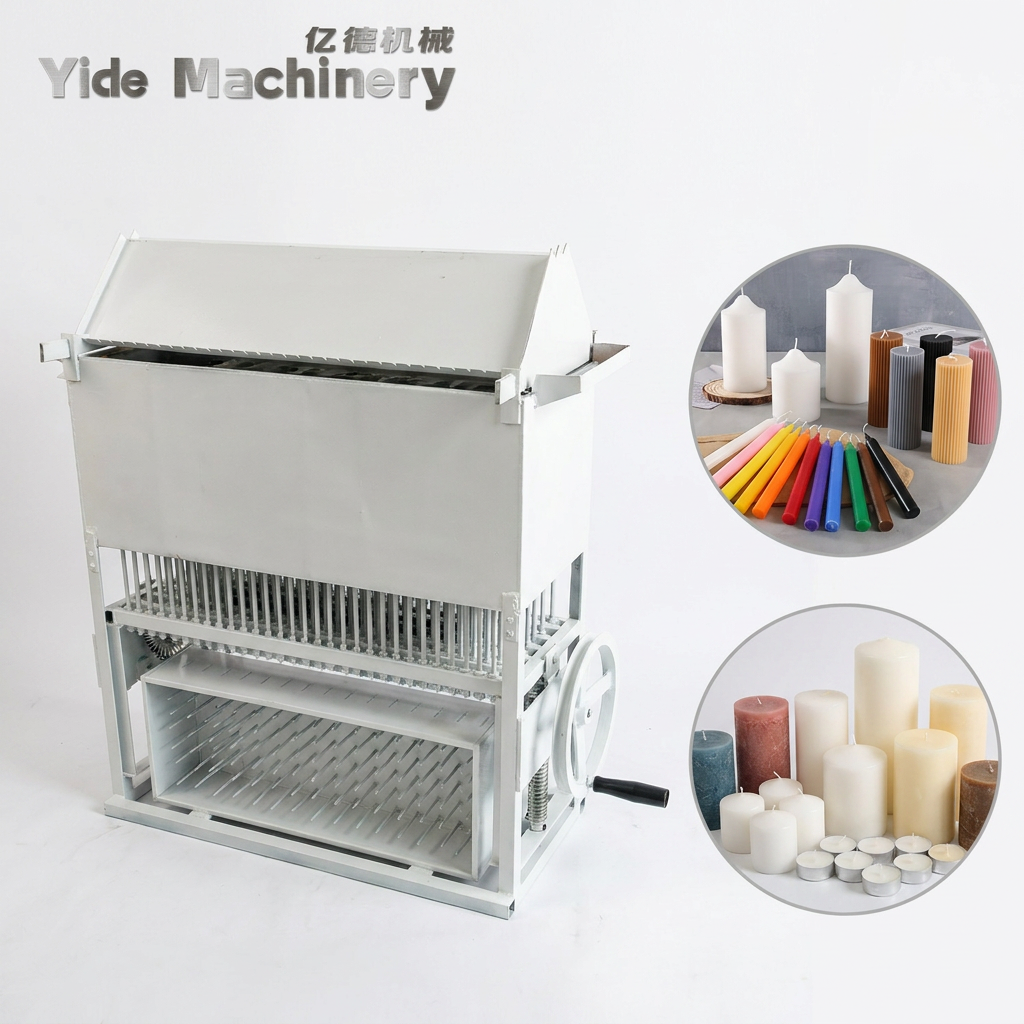
Cooling is often the most misunderstood bottleneck in candle manufacturing. You cannot rush physics, but you can definitely engineer a better environment for it.
Wax crystallizes and shrinks as it transitions from liquid to solid. The speed of this transition determines the structural integrity of the candle. Rapid cooling shocks the wax, leading to internal cracking and brittle surfaces. Slow cooling kills your production efficiency and often invites frosting in soy blends. You need a controlled, engineered thermal drop.
As wax cools, it pulls away from the center, creating a void around the wick. Artisans manage this through a "second pour" or top-off. They poke relief holes into the cooling wax and pour a second layer to fill the sinkhole. This doubles the handling time for every single unit.
Commercial equipment bypasses the second pour entirely through advanced thermodynamics. Modern machines utilize integrated, closed-loop water circulation around the mold cavities. This water jacket allows operators to control the exact rate of thermal reduction.
Controlled cooling creates deliberate, uniform shrinkage. The wax pulls away from the mold walls simultaneously, pushing the remaining liquid wax downward to fill any internal voids. This eliminates the need for a secondary pour and drastically accelerates cycle times.
Table: Cooling Method Comparison
Cooling Variable | Manual Ambient Air | Industrial Water-Jacket |
|---|---|---|
Cycle Time | 4 to 8 hours | 15 to 45 minutes |
Temperature Control | Vulnerable to room drafts | Precisely engineered |
Shrinkage Defect Rate | High (requires top-offs) | Nearly eliminated |
Surface Finish | Inconsistent, prone to frosting | Smooth and uniform |
The cooling phase ends when the wax fully solidifies. Now you face the physical challenge of extraction. The rigid pillar must exit the mold without marring the surface texture or snapping the wick.
Wax naturally wants to grip the inside of a mold. Even with maximum shrinkage, a microscopic layer of friction remains. Overcoming this barrier safely represents the final hurdle of molding.
Manual makers often pull candles by the wick. This risks snapping the cotton core entirely. Others use compressed air to force the candle out. Both methods introduce human error, leading to high scrap rates, surface scratches, and broken corners.
Industrial machinery removes human force from the equation. An Automatic Pillar Candle Machine employs sophisticated mechanical push-rod or hydraulic lift systems.
The water jacket slightly chills the mold one final degree, maximizing the microscopic air gap between the wax and the metal.
The hydraulic pistons gently push the base of the candle upwards.
The candles rise out of the cavities simultaneously, completely frictionless.
Because the push rods apply even pressure across the entire base, the surface remains pristine. You never risk snapping the wick.
Post-demolding involves final preparations for retail. Automated lines often integrate wick trimming stations that cut every wick to a standard quarter-inch height. Additionally, they utilize base leveling plates. These heated plates quickly melt the bottom of the pillar flat, ensuring it stands perfectly straight on a retail shelf or consumer table.
Common Mistake: Never force a stuck candle out of an automated mold. If a unit sticks, your cooling water temperature was likely set too high, preventing adequate shrinkage. Adjust your chillers before applying physical force.
Once you understand the mechanics, you must select the right architecture for your factory floor. Evaluating equipment requires balancing your physical space against your production goals.
You must assess the physical space required for different machine layouts. Rotary molding machines arrange cavities in a circular format. They offer an incredibly compact footprint, making them ideal for smaller industrial spaces. However, straight-line molding machines offer higher peak hourly output. They spread molds across a long track, allowing multiple pouring and cooling stages to happen simultaneously. Choose straight-line layouts if warehouse space allows and high volume demands it.
Evaluate whether your product catalog changes frequently. Do you make 3-inch, 4-inch, and 6-inch diameter pillars in the same week? If so, you need a machine that supports quick mold changeovers. Modular plates allow your technicians to swap cavity sizes in under an hour.
Conversely, if you supply big-box retailers with a single SKU, flexibility matters less. You should invest in a dedicated, single-SKU mass production unit. These highly specialized machines sacrifice modularity for raw speed and uninterrupted reliability.
Use this simple logic when hunting for a Pillar Candle Machine:
For diverse, mid-volume catalogs: Prioritize machines with modular molds and easily adjustable volumetric pour settings.
For high-volume, uniform production: Prioritize raw cycle speed, advanced hydraulic ejection, and integrated closed-loop cooling efficiency.
Transitioning from manual to automated pillar candle production is not just about buying a machine. It is about standardizing a highly sensitive thermal process. You are replacing unpredictable environmental factors with controlled engineering.
A well-integrated machinery line pays for itself by turning unpredictable manual artistry into a predictable, scalable, and profitable manufacturing formula. You reduce scrap rates, optimize labor, and deliver flawless inventory to your wholesale buyers.
Your next action should be auditing your current operations. Track your daily defect rates and measure your manual cycle times. Use this data to build a solid business case for automation. Finally, always request specific material-compatibility tests from equipment manufacturers to ensure their systems can handle your unique wax blends.
A: Yes, but it requires highly adjustable temperature controls and different cooling cycle times. Paraffin shrinks predictably, while soy blends are stickier and more temperature-sensitive. This is why specialized equipment is often preferred for 100% natural formulations to prevent surface frosting and adhesion issues.
A: Standard automated machines generally produce smooth, flawless finishes. However, specific textured molds or intentional post-processing cooling techniques can be integrated into the cycle. By altering the water jacket temperatures, operators can deliberately create rustic, mottled, or crystalized effects on the pillar surface.
A: You can expect realistic baseline estimates of 15 to 30 minutes per batch. This depends heavily on the candle diameter and the efficiency of the cooling technology. This sharply contrasts with the multi-hour cooling times required in ambient manual production setups.
A: No. Precise volumetric temperature control and water-jacketed cooling systems manage wax shrinkage dynamically. The wax cools uniformly, pushing liquid wax downward to fill internal voids. This completely eliminates the severe sinkholes that mandate secondary pours in manual crafting.