Views: 0 Author: Site Editor Publish Time: 2026-11-11 Origin: Site


In candle manufacturing, wick length governs the entire combustion process. It dictates fuel delivery rates, flame temperature, and emissions. If an untrimmed wick burns in an enclosed vessel, dangerous secondary ignitions or glass fractures often follow. Regulating this variable ensures compliance with global safety benchmarks like ASTM F2417. As candle brands scale past artisanal pouring toward industrial output, manual post-pour trimming triggers critical line delays. Hand shears produce erratic heights, dragging down throughput and raising labor overhead. Plant managers, operations heads, and expanding candle founders must treat wick sizing as a strict mechanical parameter. Precise Wick Length Control prevents excessive flame heights, keeps soot minimal, and eliminates vessel thermal shock. This guide explores the engineering behind uniform cutting systems, comparing manual tools against high-speed inline machinery.
Sub-millimeter wick length control is essential to prevent container overheating, mushrooming, and soot complaints.
Manual trimming tools introduce high labor costs, worker fatigue, and standard deviations exceeding ±3mm across high-volume production.
Implementing a dedicated wick cutting machine stabilizes trim height within ±0.5mm, protecting brand reputation and safety certification.
Automatic wick cutting machine selection depends on line speed, container height variability, multi-wick configurations, and blade metallurgy.
ROI is driven by labor reallocation, reduced QA reject rates, and the elimination of post-cure finishing bottlenecks.
Candle combustion relies entirely on capillary dynamics. The porous core pulls molten wax upward into the reaction zone. When a wick extends beyond designated thresholds, it draws excess liquid fuel. This imbalance disrupts the fuel-to-oxygen ratio. Heavy carbon soot quickly forms, sending black plumes across consumer ceilings.
ASTM F2417 establishes strict safety baselines for candle fires and burn behavior. It limits peak flame heights to three inches (76 mm) across continuous burn periods. A long wick immediately spikes initial flame heights past this safety margin. Excessive heat radiates directly against container walls, causing thermal stresses that crack thick glass jars. In extreme scenarios, unvaporized fuel pools on the surface and flashes over entirely.
Conversely, trimming a wick too short triggers immediate burn failures. When the wick lacks adequate clearance above the wax plane, the molten pool drowns the flame. The candle then tunnels straight down the center, leaving unburned margins around the jar. Standardized mechanical trimming safeguards your burns against both destructive failure modes.
Consumer expectations have evolved rapidly over the past decade. Buyers view untrimmed wicks as an unfinished defect rather than a rustic feature. If consumers must hunt down domestic scissors before lighting your product, satisfaction drops immediately. A clean, pre-trimmed wick delivers an effortless first-burn experience right out of the box.
Beyond consumer sentiment lies tangible financial liability. Erratic wick lengths trigger product returns and severe merchant chargebacks. Big-box retailers run rigorous quality audits; they penalize suppliers whose goods generate customer property complaints. If thermal fracture shatters a jar in a customer home, insurance claims and brand damage escalate rapidly.
Manual inspection stations also create heavy line friction. When operators must visually inspect each jar and gauge wick variance by eye, throughput stalls. Your facility loses productive hours to repetitive secondary rework, driving up cost per finished unit.
Craft operations frequently depend on a traditional manual Candle Wick Cutter. These scissor-like tools incorporate an angled foot intended to rest flat on the wax. In real factory environments, workers rarely hold them perfectly level. Hand angles drift, producing skewed diagonal cuts across the wick tips.
Operator fatigue introduces severe quality variances. Squeezing heavy shears thousands of times per shift induces carpal tunnel symptoms and repetitive strain injuries (RSI). As muscles tire over an eight-hour shift, dimensional variance widens dramatically. The first batch of the morning might measure a crisp 6 mm, while late afternoon runs wander past 10 mm.
Throughput ceilings restrict manual methods permanently. A skilled operator trims roughly 120 to 250 units per hour under continuous focus. If your filling line delivers 1,500 units hourly, you must station six to eight workers solely for snipping wicks. This labor allocation wastes operational capital and restricts growth.
Semi-automated bench stations bridge the gap between hand scissors and continuous automation. These units use a pneumatic cylinder or an electric actuator connected to a foot pedal. The operator slides the candle jar into a cradle, presses the switch, and a guarded blade snaps down cleanly.
These bench devices suit intermediate production batches between 500 and 2,000 units daily. They feature rigid mechanical depth stops, keeping trim heights consistent within ±1 mm. They also protect workers from RSI because pneumatic actuators handle all cutting pressures.
However, bench trimmers still demand dedicated labor. A technician must pick up, place, activate, and set down every container individually. While cutting quality improves, your plant throughput remains tethered to human cycle speeds.
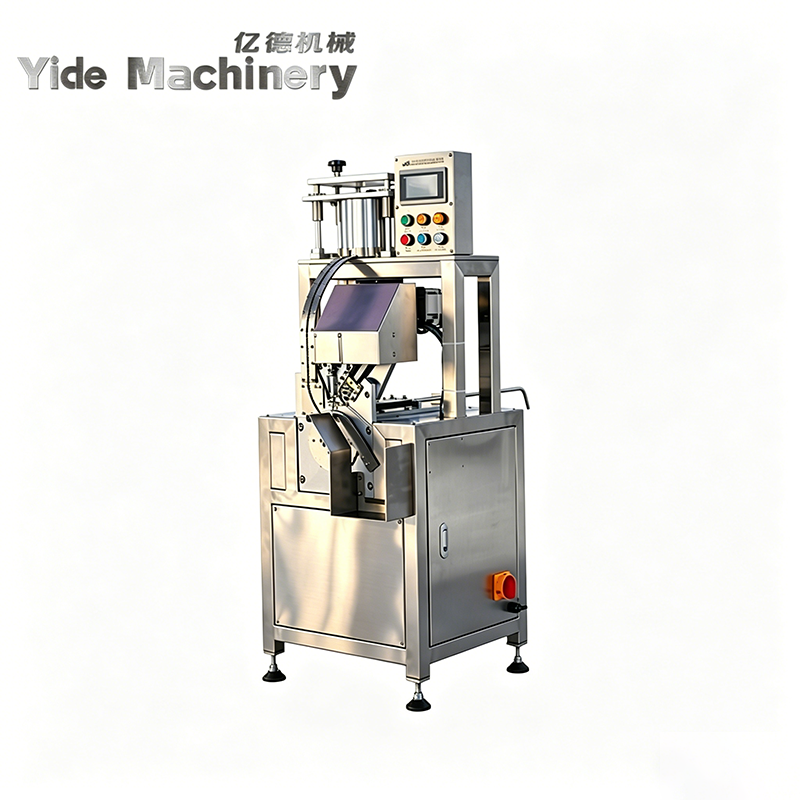
Modern production facilities mount an inline Automatic Wick Cutting Machine straight into the conveyor network. You position this station immediately downstream of your cooling tunnel or refrigeration spirals. Candles arrive fully solidified, index beneath the cutting head, and proceed directly to labeling and box packing.
These industrial machines integrate advanced indexing screws, multi-head cutters, and vacuum scrap removal hoods. They trim multiple wicks simultaneously in multi-wick vessels without shifting wick centerlines. Modern optical sensors gauge jar positions without contacting delicate wax surfaces.
Operating speeds jump to 1,500 to 6,000 units per hour. Dimensional tolerances tighten down to ±0.5 mm or better. The line moves continuously without manual touchpoints, safeguarding both margins and final package aesthetics.
Trimming System Type | Output Rate (Units/Hour) | Height Tolerance | Labor Requirement | Safety & RSI Risk |
|---|---|---|---|---|
Manual Hand Cutters | 120 – 250 | ±2.5 mm to ±4.0 mm | High (1 operator / line) | High ergonomic strain |
Pneumatic Bench Units | 400 – 700 | ±1.0 mm to ±1.5 mm | Medium (dedicated loader) | Low ergonomic strain |
Continuous Inline Machine | 1,500 – 6,000+ | ±0.3 mm to ±0.5 mm | Zero (integrated line) | Virtually non-existent |
Wax fill heights vary naturally across batches due to cooling shrinkage, ambient temperatures, and dispenser volume drift. If your cutting machine registers its stop exclusively against the glass jar rim, final wick lengths above the wax will fluctuate. Advanced machinery incorporates floating mechanical shoes or non-contact optical laser sensors. These sensors detect the actual wax surface, establishing a uniform cut datum every cycle.
Multi-wick vessels present complex spatial challenges. Double and triple-wick jars require synchronized cutting mechanisms. If a single blade approaches sideways, it can pull flexible braided wicks inward, bending them off-center before the shear completes. Dedicated multi-head modules clamp and trim each wick straight down along its vertical axis.
Vessel stability requires equal engineering attention. Lightweight glass, tapered ceramics, or oval containers tip easily when conveyor belts accelerate. Your trimming cell must incorporate timing screws, side-grip belts, or precision puck transport systems to lock each jar firmly during the cut stroke.
A high-speed Wick Cutting Machine relies heavily on durable blade geometry. Trimming stations generally deploy either guillotine shear blades or high-speed rotary cutters:
Guillotine Shears: Linear knives that pinch against a flat anvil or bypass an opposing counter-blade. They fit compact spaces and cut thick cotton braids reliably.
Rotary Shears: High-speed spinning discs that slice wicks cleanly across stationary dies. They excel in high-speed, continuous-motion conveyors.
Blade Steels: Hardened tool steels (D2, M2) offer great toughness. Tungsten carbide inserts deliver superior edge retention, resisting abrasive coatings and paper cores for millions of cycles.
Clean shear dynamics prevent frayed wick ends. When dull blades mash a braided cotton wick, individual fibers separate and spread. These loose fibers ignite irregularly, shedding carbon debris into the clean wax pool. Rigid wooden wicks require sharp guillotine action to avoid splitting down the grain.
Scrap handling must operate flawlessly. Severed wick tips carry paraffin and microcrystalline wax coatings; if dropped, they mar the warm candle top. Industrial cutters employ continuous high-flow pneumatic vacuums right beside the blade edge. The system snatches cut fragments mid-air, routing them into an external collection hopper.
Wick coatings carry specialized chemicals, including natural beeswax blends, synthetic wax stabilizers, and chemical flame retardants. These compounds gradually leave sticky deposits across cutting surfaces. Plants must track Mean Time Between Sharpening (MTBS) carefully to prevent blade binding.
Quick-change modular tooling minimizes downtime between product runs. If your facility fills 8-ounce tumblers in the morning and 14-ounce wide jars in the afternoon, operators must reconfigure the station quickly. Tool-less hand dials, digital readouts, and snap-in container guides allow technicians to adjust cut heights and line widths in under five minutes.
Integrating an automated trimmer requires careful cycle-time balancing. If your filling nozzles dispense 40 jars per minute, your cooling tunnel must release 40 jars per minute. The trimming head must operate slightly faster than upstream stations to avoid container backups inside cooling zones.
Conveyor stability remains paramount. Cured wax surfaces remain soft for several hours after exiting chill tunnels. Harsh stops, conveyor vibration, or jittery transfer plates can crack brittle wax mantles or tilt delicate wicks. Smooth variable-frequency conveyor drives eliminate these cosmetic flaws.
Utility supplies must meet machine specifications on the factory floor:
Clean, dry compressed air (typically 6–8 bar) to cycle pneumatic shear heads without water contamination.
Stable electrical supply (220V/380V depending on motor configurations and onboard vacuum motors).
Adequate conveyor straightaways (typically 1.5 to 2.5 meters) to accommodate indexing gates, safety guards, and reject diverters.
Automating your wick finishing line eliminates recurring manual labor hours. A plant running two shifts often reallocates three to six workers to higher-value packaging roles. Cutting out manual shears also reduces scrap rates caused by operator errors, like wicks chopped too short for retail sale.
Brand protection generates major soft returns. Uniform wick heights ensure compliant burn testing during distributor spot-checks. You avoid the catastrophic expenses tied to product recalls, broken retail relationships, or burn-related legal claims.
Most mid-sized to large candle factories recover their machinery investment within 6 to 14 months. High-volume contract manufacturers often recoup capital faster by running continuous double shifts without stopping for human break cycles.
Wax buildup represents the most common operating hazard. Over hours of continuous production, warm ambient air and friction cause trace wax to film over cutting edges. You can resolve this issue by integrating low-wattage heating strips near the shear block or specifying non-stick blade coatings like PTFE or titanium carbon-nitride.
Wick displacement is another frequent challenge. If a dull cutter pushes against a stiff braided wick, it can dislodge the wick tab from the bottom of the container. Sharp shear edges, proper anvil clearances, and top-down wick clamp fingers prevent lateral torque during the cutting stroke.
Selecting suitable trimming equipment requires matching mechanical capabilities to current and projected volumes. Over-engineering strains early capital, while under-engineering creates stubborn bottlenecks.
At low volumes, your factory priorities center on standardization over pure speed. Calibrated benchtop cutters with mechanical stops serve this bracket best. They eliminate manual measurement errors without requiring massive floor space or integrated conveyor feeds.
Growing operations face severe labor constraints during peak holiday production runs. Semi-automated rotary indexing tables or stand-alone pneumatic trimming machines offer the best compromise. They trim hundreds of containers per hour reliably, keeping changeover procedures fast when handling diverse container catalogs.
High-volume commercial plants require continuous conveyor automation. A synchronized, inline cutting station with optical height verification, automated scrap extraction, and upstream-downstream interlocks is essential. These units ensure 24/7 reliability, zero-defect quality control, and minimal operator oversight.
Wick length functions as an exact combustion specification rather than a casual packaging choice. Precise dimensions protect containers from thermal stress, eliminate excess soot, and ensure complete regulatory compliance. Transitioning from variable manual snipping to automated trimming equipment stabilizes your output and protects brand equity.
Take these practical steps to elevate your candle finishing operations:
Measure wick length variances across your current finished batches to calculate your active standard deviation.
Audit manual trimming labor hours, calculating true labor overhead per thousand finished units.
Send your production containers, waxes, and wick styles to machinery builders for cut-cycle trials and blade life assessments.
A: The global industry standard is 1/4 inch (approximately 6 mm) above the wax surface. This height balances rapid ignition and smooth capillary draw with modest initial flame heights. It prevents heavy soot bursts and minimizes vessel overheating during the critical first hour of burning.
A: Yes, provided the system uses appropriate blade metallurgy and shear geometry. Braided cotton bends easily and demands sharp scissor-action shearing to avoid fraying. Rigid wooden wicks require a reinforced guillotine blade that shears cleanly across the wood grain without splitting the base.
A: Advanced machines avoid fixed container-rim reference stops. Instead, they utilize floating mechanical contact feet or non-contact optical sensors. These mechanisms gauge the actual solidified wax pool surface, ensuring a uniform cut length regardless of minor fill volume drift or glass wall height differences.
A: Hardened tool steel blades typically process 250,000 to 500,000 cycles before requiring edge servicing. Premium tungsten carbide cutters often exceed 1,500,000 cycles. Abrasive paper cores, copper-wire inserts, and stiff waxing compounds accelerate wear, requiring scheduled monthly inspection routines.